
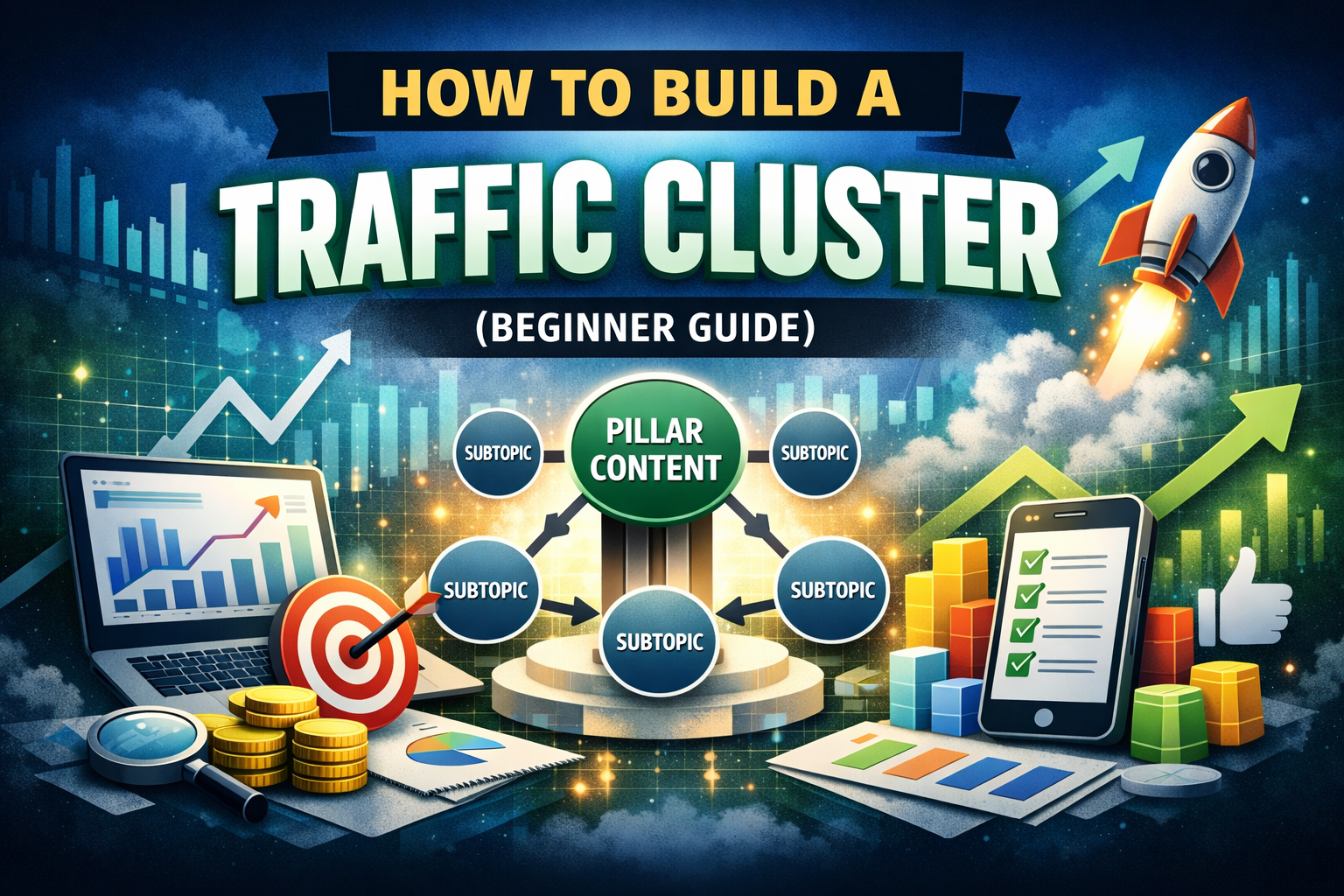
If you want consistent traffic, faster rankings, and a content plan that never leaves you guessing what to write next — you need a traffic cluster. It’s the simplest way for beginners to build authority without publishing hundreds of articles.
Introduction
A traffic cluster is one of the simplest and most powerful ways for beginners to build long‑term, consistent website traffic. Instead of publishing random posts and hoping something ranks, a cluster gives Google a clear, organized structure that shows exactly what your site is about. When your content is grouped around one main topic — with supporting articles that reinforce it — Google can understand your expertise faster, trust your site more, and reward you with higher rankings. If you want predictable traffic without needing hundreds of posts, this is where you start.
Why Traffic Clusters Matter
Traffic clusters help beginners rank faster because they create topical authority. Instead of publishing random posts, you’re building a focused ecosystem of content that all supports one theme.
Clusters improve:
- Crawlability — Google can easily navigate your content
- Relevance — your articles reinforce each other
- Engagement — readers stay longer and click deeper
- Rankings — Google rewards organized, topic‑driven sites
If you want long‑term traffic, clusters are the foundation.
Step 1 — Choose Your Pillar Topic
Your pillar topic is the “hub” of your cluster. It’s the broad, high‑level article that everything else connects to.
A strong pillar topic is:
- Beginner‑friendly
- Broad enough to support multiple subtopics
- Low to medium competition
- High search intent
Examples:
- Affiliate Marketing for Beginners
- Free Traffic Sources
- SEO for Beginners
- How to Start an Online Business
If you’re brand new to SEO, reading What Is SEO? helps you understand why pillar topics matter.
Step 2 — Identify Supporting Articles (Cluster Posts)
Your supporting posts are the “spokes” of the cluster. Each one covers a subtopic that reinforces the pillar.
Examples for a pillar on “Affiliate Marketing for Beginners”:
- Affiliate Marketing Mistakes Beginners Make
- How to Choose a Profitable Niche
- Best Free Traffic Sources for Beginners
- How to Promote Affiliate Links Without a Website
- Affiliate Marketing Terms Explained
If you struggle to find topics, Beginner Keyword Strategy shows you how to pick cluster‑friendly keywords.
Step 3 — Create Your Internal Link Structure
Internal links are what turn a group of articles into a true cluster.
Your structure should look like this:
- Pillar → links to all supporting posts
- Supporting posts → link back to the pillar
- Supporting posts → cross‑link to each other when relevant
This creates a clean, circular flow that signals authority and relevance.
If you’re new to internal linking, How SEO Works for Beginners explains why Google relies on these connections.
Step 4 — Optimize Each Article for SEO
Every article in your cluster should follow basic on‑page SEO:
- Clear H2/H3 structure
- Beginner‑friendly formatting
- Strong meta title + description
- Optimized images with alt text
- Internal links placed naturally
- Clean, readable paragraphs
If you want help writing better content, read How to Write Blog Posts That Get Traffic.
Step 5 — Track and Strengthen Your Cluster
Once your cluster is live, monitor it in Google Search Console.
Look for:
- Which articles are getting impressions
- Which keywords are rising
- Where internal links can be improved
- Which posts need updates or expansion
If you’re just starting out, Get Your First 100 Visitors is a great next step.
Clusters grow over time. As your site gains authority, you can add new supporting posts and strengthen the ecosystem.
Common Mistakes to Avoid
Beginners often make these mistakes:
- Choosing subtopics that don’t relate to the pillar
- Forgetting internal links
- Publishing without keyword intent
- Over‑optimizing or repeating content
- Creating too many clusters at once
Focus on one cluster until it’s complete — then move to the next.
Final Thought
Traffic clusters compound over time. The more you build, the stronger your authority becomes. You don’t need hundreds of posts — you just need a focused system that Google can understand.
Final Verdict
A traffic cluster =
One pillar + multiple supporting posts + strong internal links.
This is the simplest, most reliable way for beginners to build long‑term traffic and authority.
Start Building Your Cluster Today
If you want to build your first traffic cluster faster — without confusion or guesswork — use the AI Outline Workflow Assistant. It builds clean, optimized outlines in seconds so you always know your next step.
FAQ
What is a traffic cluster?
A traffic cluster is a group of related articles built around one main pillar topic to build topical authority and improve rankings.
How many articles do I need?
Start with 1 pillar and 3–5 supporting posts. Expand later as your site grows.
Do I need backlinks?
No. Internal links are the priority. Backlinks help, but they’re not required to start ranking.
How long does it take to rank?
Most beginners see movement within 30–90 days, depending on competition and consistency.
Can I build multiple clusters at once?
You can, but beginners should focus on one cluster at a time for faster authority.
Related Guides
These guides strengthen this article and help you take the next step:
- What Is SEO?
- How SEO Works for Beginners
- Beginner Keyword Strategy
- How to Write Blog Posts That Get Traffic
- Get Your First 100 Visitors
- Traffic Mistakes Beginners Make
Tools Hub
These free tools help you plan, write, optimize, and scale your entire traffic cluster faster — even if you’re a complete beginner.
- Content Idea Generator
- Content Outline Builder
- AI Content Enhancer
- SEO Content Optimizer
- Keyword Research Assistant
- AI Outline Workflow Assistant
- AI Prompt Builder

Frederick Croniser shares practical tips, tools, and resources to help make building income online simpler and more approachable. Through this website, Frederick provides helpful content and recommendations, including the Plug-In Profit Site, a system designed to help beginners get started online with a website, step-by-step training, and built-in income streams. Learn more about getting started with Plug-In Profit Site here.